

Takeout program for the private market leads the list
 Contained within the FEMA Review Council’s final report is perhaps one of the most important and far-reaching changes for the Sunshine State – a proposal to jettison National Flood Insurance Program (NFIP) policies to private insurance companies in an effort to shrink federal engagement in disaster recovery. The 75-page report notes NFIP’s current $22.5 billion debt (plus the previous $16 billion forgiven debt) and its reliance on outdated risk information in calculating premiums − and offers privatization through a takeout program as a solution. This change would impact Florida the most, as it has the largest share of NFIP’s 4.7 million policies at 1.7 million, almost 20% of Florida homeowners.
Over the past 20 years, Florida and FEMA have gone hand-in-hand in disaster relief, with 14 major disaster declarations and billions in payments to local governments after catastrophes like hurricanes Debby, Helene, and Milton. Several billion dollars alone have gone towards repairing tens of thousands of flooded Florida homes. While private flood insurance coverage has grown here in Florida (57 companies now write) and nationally (about 27% of the overall market), the belief is more can be done. Back in January we reported on Neptune Flood’s pitch to the White House, claiming the private sector could take on 95% of NFIP’s policies. While the Council’s report does not offer hard numbers in private flood insurance market carrying capacity, it is adamant in its stance on the shift, calling the current model “unsustainable … [unable to] meet conflicting expectations of providing affordable insurance, mitigating flood risk, and maintaining financial solvency.”
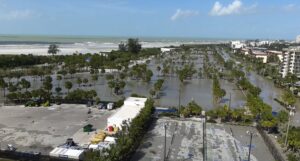
Widespread flooding from Hurricane Helene storm surge on Siesta Key Beach in Sarasota County, September 27, 2024. Courtesy, Sarasota County
What material changes are suggested? To start, continuing with stringent risk-based pricing under the NFIP’s Risk Rating 2.0 to delineate between high and low flood risk properties. Also, addressing repetitive-loss properties that cause a disproportionate amount of cost impact in the insurance pool via either buyouts or infrastructure improvements. This could mean something like the My Safe Florida Home Program we regularly cover, or even come down to elevating homes, which has been a popular mitigation effort in Florida. Also, revising “Write Your Own” compensation to reduce overall administrative costs. But obviously, the biggest suggestion “involves a shift to a private market framework.”
Many believe it’s possible, including Robert Norberg, President of Arden Insurance Associates in Lantana, who told the Palm Beach Post that he can see the private market taking on an even bigger piece of the pie. “In probably 70% or more of my new business, flood (insurance) has gone to the private market,” he said. Others are a little more cautious. Mark Friedlander with the Insurance Information Institute acknowledges that private flood insurance innovations have “advanced analytics and improved data to better assess flood risk and offer alternatives to the federal program,” but contends that they cannot take on the risk federal flood insurance currently holds. The latest “data shows rising flood risks and low coverage rates,” Friedlander told the Post. “While private flood insurance is growing, NFIP remains vital for providing widespread, actuarially sound coverage against damages excluded from standard homeowners policies.” While federal policies still tend to be less expensive, private market policies have greater coverage and more comprehensive benefits than NFIP policies.
Implementing the Council’s recommended NFIP changes could occur through a future amendment to the current FEMA Act in Congress or more likely, addressed by the House Committee on Financial Services in separate legislation.
 LMA Newsletter of 5-18-26