

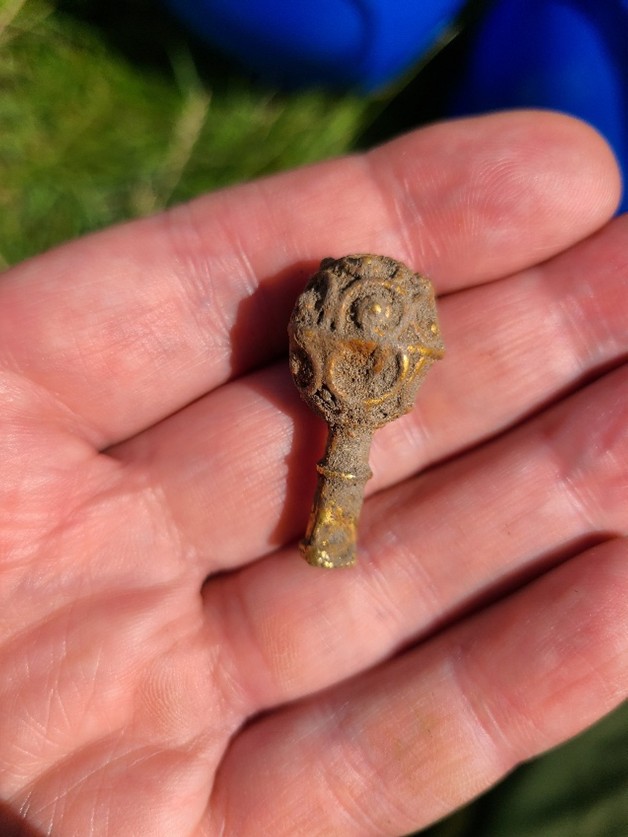
The gold object discovered in Northumberland, Credit, Newcastle University
Call it beginner’s luck, serendipity, or innate archaeological ability – but striking gold on your first dig is anything but ordinary. Enter Yara Souza, a University of Florida archaeology student, who unearthed a rare piece of ninth-century gold on her first university excavation in Northumberland, England in July. The group was shocked when Souza walked onsite and in only 90 minutes, pulled a golden artifact from the dirt.
At one and a half inches long, the golden pieces shined through the dig site dirt – their shape and carvings showing that the pieces were ornamental but must’ve held some cultural importance. Pictures of Yara and her professor/tutor James Gerrad holding the medieval medals show they’re barely the size of your finger, but their discovery is worth more than their weight in gold.
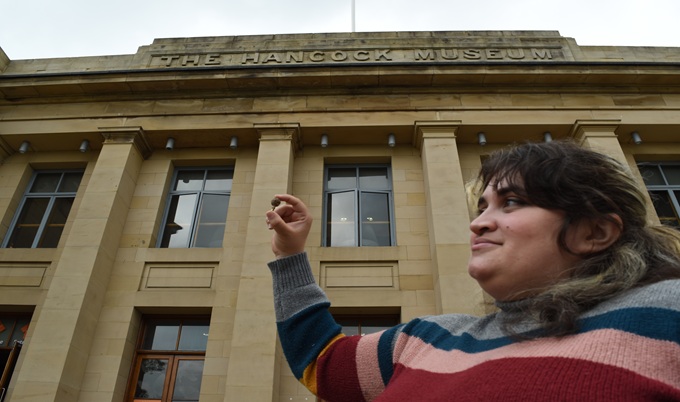
Yara Souza with the early medieval gold object she discovered in Northumberland. Credit, Portable Antiquities Scheme/Newcastle University
“This is an exciting find of exceptional quality, and I’m delighted for Yara that she has made this discovery at the beginning of her career as an archaeologist,” said Gerrard, Professor of Roman Archaeology at Newcastle University.
The dig site is on an old Roman road called Dere Street that ran between York and Edinburgh, used well after the fall of Rome. Dated to sometime in the 800s, the find offers great insight into the area, as experts believe the objects could have religious or ceremonial significance since gold was a symbol of high status, and Dere Street connected two religious hubs. They even offered the theory that the gold could’ve been buried on purpose.
The finds still come with some shock for the beginners, with Souza sharing, “I couldn’t believe I’d found something so quickly into my first ever excavation. It was actually quite overwhelming.” Yara had missed out on an excavation program at a different Roman fort in 2024 due to an illness, so this felt like a suitable welcome back. She told the university’s press office, “After I’d had to miss Birdoswald last year, it was amazing to discover something that hasn’t been seen for more than a thousand years. I was really geeking out over it!”
Other archaeological teams have been busy across England, where in June a team excavating the Magna Roman Fort found a 2,000-year-old, size-14 boot from a Roman soldier. Yara and other bright young minds are the future of better understanding the past. With such talent at the helm, archaeological teams worldwide will continue to find artifacts that enrich our understanding of our history and the beaten paths of the millions of people before us who shaped it.
See you on the trail,
Lisa
LMA Newsletter of 9-8-25