

Plus, better & less expensive shoreline protection
 A new landmark agreement between Florida and the federal government could mean faster Everglades restoration, the Sunshine State has a new approach to raise water quality, and a study shows living shorelines can provide better and cheaper protection during major storms. It’s all in this week’s Environmental and Engineering Digest.
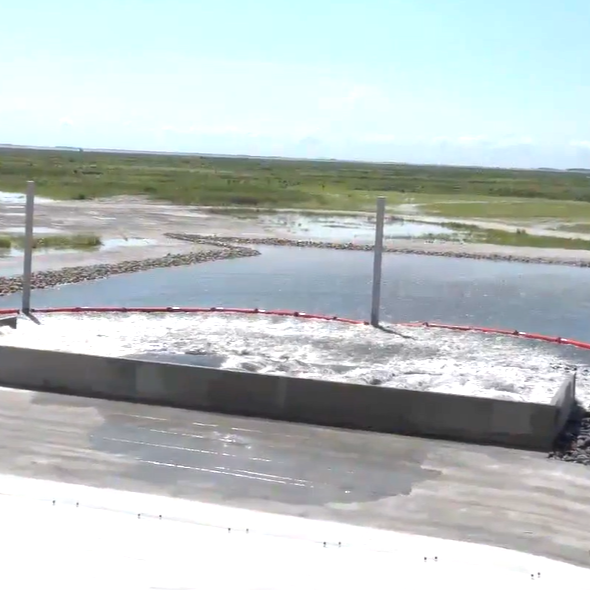
Water flows into the new Caloosahatchee C-43 Reservoir near Lake Okeechobee in Hendry County, July 15, 2025. Courtesy: South Florida Water Management District
Everglades on Overdrive: Earlier this month, Governor Ron DeSantis announced an agreement between the State of Florida and the U.S. Department of the Army and its Corps of Engineers, wherein Florida will take the lead on several components of the Comprehensive Everglades Restoration Plan (CERP). This includes the Everglades Agricultural Area (EAA) Reservoir, colloquially known as the “crown jewel” of current Everglades restoration efforts, which will hold 78 billion gallons of water and deliver up to 470 billion gallons of clean water to the Everglades and wider Florida Bay once completed. With the reigns, Florida will be authorized to construct inflow and outflow pump stations, accelerate the EAA Reservoir’s construction schedule by five years, and “fast-track critical restoration efforts” to take better care of the Everglades National Park. The project will redirect Lake Okeechobee discharges south, restoring ecosystems, and significantly reducing harmful discharges to the Caloosahatchee and St. Lucie estuaries that have created regular blue-green algae blooms.
Florida has already been doing a great job with Everglades restoration. Just days before the Army agreement announcement, the Caloosahatchee (C-43) Reservoir was officially opened, a 10,000-acre reservoir capable of moving 650,000 gallons per minute, to help improve water quality and Florida’s water storage capacity. Currently, Florida has completed or started construction on more than 75 Everglades restoration projects since 2019, making strides in conservation, stewardship, and ensuring the beautiful Everglades are here to stay.
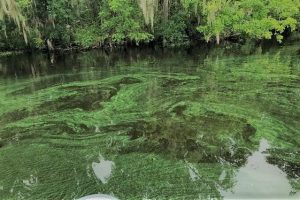
Blue-green algae in the Indian River Lagoon. Courtesy, Central Florida Kayaking
Improving Florida Water: Florida’s Department of Environmental Protection (DEP) has been hard at work on behalf of Florida’s waterways, too. Late last month, it adopted new Basin Management Action Plans (BMAPs) to reduce pollutant levels statewide, just in time for the July 1 agency update deadline imposed by the Florida Clean Waterways Act. Historically, efforts have been lackluster, with early BMAPs from 2007 onward showing inconsistent results – nitrogen was increasing by almost 1.5 million pounds per year and was heavily affecting Florida’s natural springs as late as 2018. But new plans aim to cut nitrogen levels in half by 2038 by tasking polluters with reductions for the first time, per a court order. It will put pressure on localities such as Columbia County and Lake City, who, along with agriculture and private golf courses, are responsible for half of the proposed reduction. The DEP can impose civil penalties, fines and other court-ordered injunctions on stakeholders in the problem areas if they do not comply. “For years, DEP has worked closely with stakeholders across Florida to assess water quality, establish pollution reduction goals and identify projects and strategies to achieve meaningful, measurable improvements,” said DEP Secretary Alexis A. Lambert in a June 27 press release. “Today’s adoption of these plans is a significant milestone made possible through input, collaboration and dedication.”
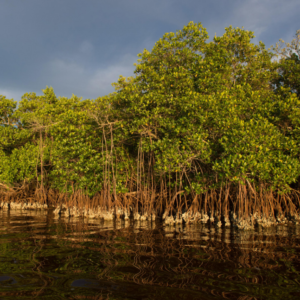
Oysters grow on the mangrove coastline of
Charlotte Harbor Estuary near Punta Gorda, Florida. Courtesy, Carlton Ward Jr. @ The Nature Conservancy
Living Shorelines: In the constant battle to save Florida’s coastline from erosion and wave action, research is continuing to show that natural barriers can be more effective than any artificial structures. A recent Springer Nature study analyzing the shoreline impact in regions around Cedar Key during Hurricane Idalia in 2023 showed that wave energy and storm surge dropped by 28% with natural barriers made from such things as recycled oyster shells. Among a long list of benefits, living shorelines are less expensive, more resilient, have lower upkeep, and use natural elements already present in most of these ecosystems. Related coastline studies in Rookery Bay in Naples also found that mangroves, another one of nature’s barriers, stopped around $1.5 billion in storm damage during Hurricane Irma back in 2017 and protected more than 600,000 people statewide.
“There is a direct economic benefit to the homeowner or property owner to install (natural barriers),” said Savanna Berry, study co-author and regional specialized extension agent at the Nature Coast Biological Station. “It was eight and a half times cheaper to install a living shoreline and 2.7 times cheaper to maintain a living shoreline than a seawall.” Officials are hopeful that this data can be included in future updates to the Big Bend Seagrasses Aquatic Preserve Plan, to better protect the titular area that spans nearly 1 million acres off Cedar Key, and is the lifeblood for local industries like clams, oysters, pink shrimp, and blue crab. Casting a wider net for ecological management may start with simple switches on the home front.
 LMA Newsletter of 7-28-25