

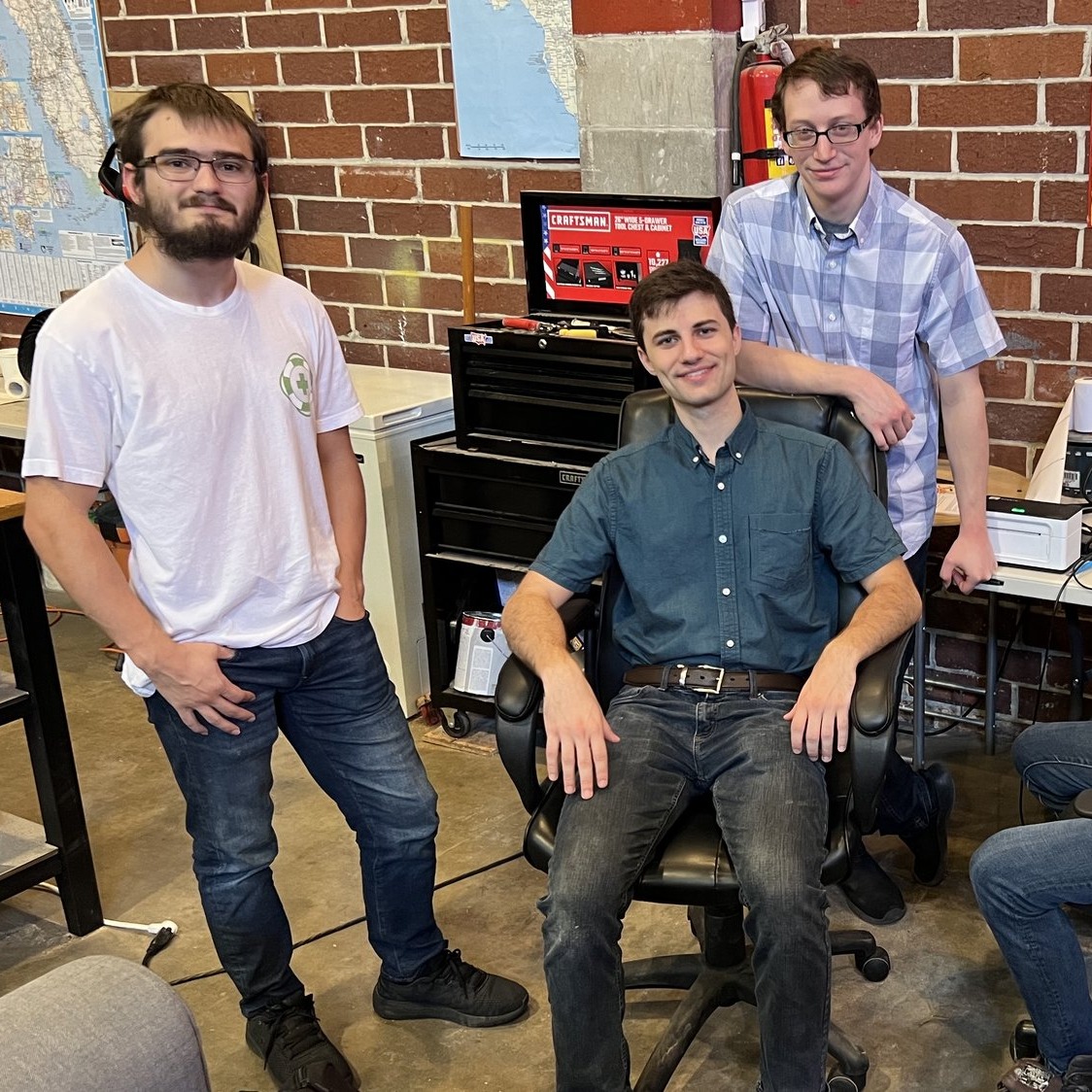
Gabe DeGaglia, Sam Baker, and colleague Italo Rangel. Courtesy, WriggleBrew
Out with the old and in with the new – that was University of Central Florida (UCF) graduate Sam Baker’s goal, when he and classmate Gabe DeGaglia set out to overhaul the fertilizer industry with good old-fashioned earthworms. It all started when Baker and his grandfather’s favorite fishing spots were overrun with algae, exacerbated by synthetic fertilizer runoff. DeGaglia pointed to the humble earthworm, whose waste (castings) is a natural fertilizer without all the excessive nitrates, and the duo got to work developing shelf stable options to get to farms across the states.
Officially launching back in March 2022, WiggleBrew saw success after success. First, they won seed funding at UCF’s top business competition The Joust, gaining their first Florida nursery and farm clients in the process. Then came the major breakthrough: the team at WiggleBrew found that these worms could also digest plastic. They got busy writing proposals to the National Science Foundation (NSF), who granted them a further $275,000 to test breaking down these plastics safely and for the development of artificial “worm guts” to speed up the process. When worms decomposed a pound of Styrofoam in just five days, they knew this was the “Eureka” moment.
More grants and funding followed – first a federal agriculture grant for $125,000, then a clean sweep in all categories for the Cade Prize for Inventivity, then the biggest kick yet: a $1.2-million Phase II grant from NSF. “That’s two sets of Ph.D. scientist review boards giving it a thumbs up. We felt like, OK, we can really do this,” Baker told Florida Trend. “The dream has been to replace synthetic fertilizer with an organic alternative in a cost-saving way for farmers, and it’s starting to manifest.”
WiggleBrew plans on breaking down a couple hundred pounds of plastic by year’s end, and hopes to be crushing tons of plastic in the coming years as the business grows. One thing’s for certain: farmers love the fertilizer. Corn and soy farmers across the Midwest have ordered 40,000 gallons of the castings for next season, and as the word spreads, so will perhaps the solution to our mounting plastic problem. Baker knows the stakes are high with microplastics finding their way into every part of our lives. “History shows us what happens when we ignore things like this … we can’t wait 30 or 40 years to find out the damage,” he said. Good thing our little worm friends are already on the case.
See you on the trail & Happy Holidays,
Lisa
 LMA Newsletter of 12-8-25