

Plus, how one hurricane community plans to spend HUD money
 FEMA slashes $300 million in Florida resilience funding, Pinellas County looks to spend big to help storm victims get back to stable housing, and the federal flood insurance program is now offering direct to consumer premium quotes. It’s all in this week’s Disaster Management Digest.
 FEMA Cutback in Florida: As part of the Trump administration’s ongoing push to disengage FEMA from state affairs, nearly $300 million in aid from the federal relief agency meant to fund hurricane resilience projects in Florida has been frozen according to reporting by the Orlando Sentinel. It’s part of FEMA’s announced end of its Building Resilient Infrastructure and Communities (BRIC) program, a significant portion of all FEMA funds received by Florida. The Sentinel reports that Congress allocated $312 million in BRIC grants to Florida from 2020-2023, and having only spent $19 million, the state will have to return the unspent balance. While detractors of this push have taken to suing the sitting administration, it is important to note that the current goal is to get the same money to states without all the federal hurdles and red tape. Neither the Governor’s office nor the state Division of Emergency Management made public comment about the end of BRIC, and while certain areas like Jacksonville and Key West were planning to use the grants for road elevation and community safe room projects, there is an outstanding sentiment that the money will come back to Florida and other states, and even more of it will reach the outstretched hands of the communities. At a February press conference, Governor DeSantis summarized the state-oriented disaster framework, saying, “Cut the bureaucracy of FEMA out entirely and that money will go further than it currently does at greater amounts going through FEMA’s bureaucracy.” We here at LMA will be following the continuing evolution of FEMA closely, because resiliency directly affects insurability.
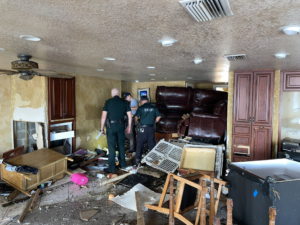
Hundreds of homes in coastal Pinellas County suffered flood damage from Hurricane Helene’s 10-15 foot storm surge. Courtesy, Pinellas County Sheriff’s Office
Pinellas Steps up to the Plate: Pinellas County, ground zero for some of the worst Florida damage from Hurricanes Helene and Milton, was recently awarded $813 million from the U.S. Housing and Urban Development’s Community Development Block Grant Disaster Recovery (CDBG-DR) fund. At a public input session last week, county staff proposed that $500 million will go toward home rehabilitation or reconstruction, $105 million to improve infrastructure, $57 million toward local landlord rental rehabilitation or reconstruction, $32 million to disaster relief payments, and $40 million toward homeowner repair reimbursement and a homeownership assistance program. HUD requires that 70% of the CDBG-DR funding be spent on low to moderate income households/communities. The money will be spent county-wide – except in the City of St. Petersburg, which received its own HUD money. Once all needs have been met in lower income areas, the county can apply for a waiver and move into other income brackets, according to Commissioner Brian Scott, who also doubled down on the importance of community input in this rebuilding process. Another public meeting is scheduled for April 24th at 6pm at Harbor Hall/White Chapel in Palm Harbor.
 FEMA’s New Flood Quote Tool: FEMA has announced a new Direct to Consumer Flood Insurance Quoting Tool to further streamline the policy purchasing process and “close the insurance gap to create a more resilient nation.” Interested homeowners and renters can access the tool on Floodsmart.gov to get an online National Flood Insurance Program (NFIP) policy quote for their property and a list of carriers from which to purchase the quoted policy. This is a huge step forward, seeing as flooding is the most common disaster across America yet less than 4% of households nationally have flood insurance. “99% of all communities have experienced a flood,” according to Elizabeth Asche, Ph.D. and senior executive of NFIP. She notes that around 40% of NFIP claims occur outside of the so-called “high flood hazard” areas. The NFIP plans on expanding the tool to allow direct policy purchases over the next year.
 LMA Newsletter of 4-14-25