

Reinsurers weigh-in on federal flood insurance changes
 Fort Lauderdale will need $1.6 billion to stave off future floods, FEMA’s new flood maps include parts of Clearwater for the first time, and reinsurers meet with the FEMA Review Council in pursuit of reforming the National Flood Insurance Program (NFIP). It’s all in this week’s Flood Digest.
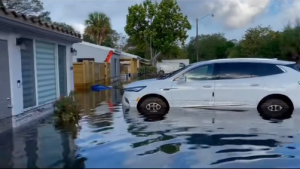
Flood waters remained to the bottom of car doors and nearly to front door knobs of homes in Ft. Lauderdale the morning after the big rain, April 13, 2023. Courtesy, Broward S.O.
Fort Lauderdale Flood Protection: At a recent City Hall meeting, Fort Lauderdale officials heard the price tag for protecting the neighborhoods from intensifying flooding: $1.6 billion, a number that left them reeling. The city was hit by catastrophic downpours in April 2023 that completely flooded low-lying neighborhoods citywide and even shut down their international airport, which set the city into action. But it’s taking more time than residents and officials would like; only two of the 25 neighborhoods on Mayor Dean Trantalis’ Fortify Lauderdale list have been finished with major drainage upgrades. And while the numbers are huge, and amount to a price per capita of $8,711, it’s critical to note that these projected costs are in 2025 dollars, and waiting will only make the cost rise. Experts have been brought in to rank the neighborhoods by need, which are then placed into one of two phases. This overhaul of an entire city worth of neighborhoods necessitates a staggered approach, so that every single suburb is not torn up at the same time – which would create a logistical nightmare for anyone trying to get around. While the city is due to get $88 million in federal payouts from prior flooding, it still needs to stagger the upgrades to avoid going into $1.6 billion of debt, unless it raises taxes. “It’s a lot of money to borrow,” Mayor Trantalis told city commissioners. “It’s unfortunate that the city of Fort Lauderdale since its inception has ignored the issue of stormwater drainage and other kinds of infrastructure. Trying to make up for the mistakes of the past in a short period of time can be burdensome.”

A woman and her dog wade through the flood water in Clearwater the morning after Hurricane Milton made landfall, October 10, 2024.
FEMA’s New Flood Maps: FEMA has released updated flood zone maps that include some areas of Florida that had never seen flooding before last year – including some Clearwater neighborhoods. Residents there are divided on the issue – many, like Clearwater local Dave Kurinsky, told Fox 13 Tampa that he will pass on purchasing flood insurance, insisting he’s on high enough ground. “If this place floods, the state will be flooded,” he said. Parts of Clearwater suffered storm surge of more than seven feet in last year’s Hurricane Helene. One apartment complex still has vacant bottom floor apartments. My interview, as part of the story, reminded viewers that homeowners insurance doesn’t cover flood damage, along with my familiar refrain: “If your driver’s license says Florida, you need flood insurance, whether or not the map says you do.” FEMA is updating flood zone maps in other areas of Florida as we reported in the Florida Insurance Roundup podcast Florida’s Expanding Flood Zones from last summer.
 Reinsurers Weigh-In: The FEMA Review Council, established earlier this year by President Trump, has been the talk of the nation for months, as its proposals will undoubtedly change the landscape of emergency management and with it, insurance. As such, the Reinsurance Association of America (RAA) met with the Council in early September, sharing recommendations for changes to the NFIP. The recommendations were catered towards giving property owners more options via increased market competition – letting private flood insurance market players into the game to reduce the federal government’s share of flood risk. Beyond this, the RAA also highlighted the urgent need for NFIP reform, due to the incongruence between floods as the most common natural disaster in the U.S. and the 92% of at-risk properties lacking any sort of flood coverage. RAA President Frank Nutter doubled down that the reinsurance sector is ready to play an integral role in the shift. “We urge the Administration and Congress to reauthorize the NFIP and work with our industry and states to expand the private flood insurance market’s role and provide property owners more flood insurance options, rather than rely on limited federal aid after an event.”
 LMA Newsletter of 9-22-25