

Plus, the latest theories on the Surfside condo collapse
 The Defense Department will no longer share some satellite data used for storm forecasts, the National Weather Service is scrambling to hire more people among a staffing shortfall in the midst of hurricane season, and the latest on the federal investigation into the deadly Surfside condominium tower collapse. It’s all in this week’s Disaster Management Digest.

An artist’s rendering of a Defense Meteorological Satellite Program satellite orbiting Earth. Courtesy, U.S. Space Force
Satellite data program stopped: The Atlantic hurricane season is in full swing, but this year forecasters have one less tool to combat the storms. The Defense Department recently informed NOAA that it will no longer be providing storm data from its Special Sensor Microwave Imager Sounder (SSMIS) come July 31. The SSMIS and other satellites from the DoD provide critical weather information from low-Earth orbit using microwaves, which are able to further penetrate into storms, and work after dark when the traditional visible light and infrared imagery are ineffective, letting us track storms while most people are sound asleep. While NOAA is adamant their other sources are still fully capable of providing cutting edge data and imaging, many are worried about the loss of data and what that means for modeling and storm updates. “We’re a bit blind now,” said Allison Wing, a hurricane researcher at Florida State University, told The Guardian. “Before these types of satellites were present, there would often be situations where you’d wake up in the morning and have a big surprise about what the hurricane looked like,” she said. “It’s not a good time to have less information.” Mark Serreze, Director of the National Snow and Ice Data Center, told NPR “It’s not an issue of funding cuts. There are cybersecurity concerns. That’s what we’re being told.”
 NOAA goes “Mission Critical”: NOAA’s impending loss of certain satellite data comes in a year of staffing cuts and reductions in scientific programs prompted by widespread federal budget cuts. Now, the agency has put out an all-call – reassigning staff and advertising for temporary hires for “mission-critical field positions” to bolster frontline operations at the National Weather Service during this hurricane season. Hundreds were fired initially, and nearly half of weather service offices have 20% vacancy rates, but now some of these positions need to be filled in order to get forecasts, warnings, and evacuation orders out to affected populations in a timely manner. Many experts warned of the danger caused by the cuts: having forecast offices cut their hours or no longer keep staff on overnight shifts at certain times could put countless lives in danger up and down the coast. The agency has not disclosed the number of positions to be reopened, nor many other details of the overhaul.
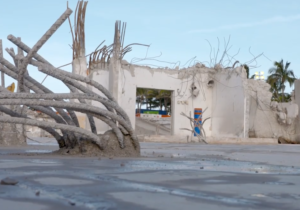
Remnants of the Champlain Towers South Condominium foundation. Courtesy, National Institute of Standards and Technology
Surfside Collapse Update: More than four years after 98 people were killed in the Champlain Towers South condominium collapse in Surfside, Florida, federal investigators are still closing in on the official cause. The National Institute of Standards and Technology is conducting the investigation and told the Associated Press it hopes to issue a report sometime in 2026. While preliminary reports in early 2024 pointed at faulty support columns in the garage under the complex and the adjoining pool deck, investigators have found two other potential causes: misplaced steel reinforcements in the same areas, and renovations around the pool (heavy planters, piles of sand and pavers) that added excess weight to an already “functionally and structurally inadequate” deck. These three “higher-likelihood” scenarios all tie back to construction flaws from four decades ago when the condos were first built. Further theories are hard to pin down because of the lack of records from the original construction, but investigators have also pointed to frequent flooding in the basement parking garage that exposed steel and concrete to corrosive elements over the years. The tragedy led to a more than $1 billion settlement with the victims’ families, and tougher safety requirements on condominium buildings from the Florida Legislature.
 LMA Newsletter of 7-14-25