

Plus, FORTIFIED homes show true insurance savings
 Florida reinsurance remains at reasonable prices for the second hurricane season in a row, a new study helps prove insurance savings from FORTIFIED-built homes, there’s a new push for federally-backed mortgages to accept actual cash value insurance policies, plus Florida regulators premier a new wind mitigation website and new catastrophe reporting forms. It’s all in this week’s Property Insurance News.
© Can Stock Photo / radiantskies
Reinsurance: Florida’s improved insurance litigation climate is one of the reasons cited for a second year in a row of lower reinsurance rates going into this hurricane season. Howden Re reports that risk-adjusted property catastrophe reinsurance rates fell from flat to down 20% at the June 1st renewals, “depending on loss experience and attachment point.” Competition from insurance-linked securities through catastrophe bonds has helped soften prices, leading to a second year of savings for Florida insurance companies. “Reinsurers underwriting in Florida appear confident in legal reforms… with legislative attempts to reverse them largely unsuccessful. This stability underpins continued, selective appetite for Florida risk,” writes Howden Re. “A 20% increase in retention levels from the Florida Hurricane Catastrophe Fund, projected at $11.3 billion for 2025, drove cedants to seek private market solutions for lower layers. However, pressure on rates at these levels was largely mitigated by increased appetite from traditional reinsurers who now view them as attractive after years of caution.”
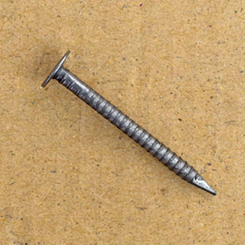
A ring-shank nail (shown) and hurricane ties are two components of the FORTIFIED standard
Tougher Homes Equals Insurance Savings: Five years ago, Hurricane Sally hammered Alabama’s coastal communities – many of which have building codes on par with the Florida Building Code – and caused over $300 million in damage. Yet, a new University of Alabama study finds the damage could have been much worse, if not for the area’s widespread adoption of the FORTIFIED construction standard developed by the Insurance Institute for Business & Home Safety (IBHS). The study shows that FORTIFIED homes were 50% less likely to have an insurance claim than a home built to strict building codes that, in many cases, mirror FORTIFIED’s requirements. One of the differences: the private enforcement mechanism for inspecting those homes. By 2020, there were more than 17,000 homes built or re-roofed to the FORTIFIED standard on the Alabama coast. The new study shows that if all homes in the area had been built to code insurers and homeowners would have saved over $140 million.
This is the proof that some in the insurance industry have been waiting for. The FORTIFIED standard does save on claims costs. It was the subject of my recent article titled No More Sticks! Florida’s Efforts to Fortify Homes for The Demotech Difference magazine. The article includes other ways homeowners can help make their homes and families safe this season.
 Pushing Actual Cash Value (ACV) Policies: A group of 17 members of Congress have written a letter to the new Director of the Federal Housing Finance Agency, William Pulte. In it, they urge Pulte to take action to require Fannie Mae and Freddie Mac to accept ACV homeowners insurance policies on homes with federally-backed mortgages. “Mandating RCV (Replacement Cost Value) policies not only restricts consumer choice but also imposes significant cost burdens on families already facing steep affordability challenges in the housing market,” states the letter. “In many regions, particularly those vulnerable to natural disasters or with elevated risk profiles, full replacement cost insurance is either prohibitively expensive or increasingly unavailable.”
 OIR News: The Florida Office of Insurance Regulation (OIR) is providing a new resource to encourage homeowners to be proactive in preventing and reducing windstorm losses. A new webpage provides details for consumers regarding the process of requesting a wind mitigation inspection, updating and submitting necessary wind mitigation forms, obtaining information about mitigation programs available, as well as other mitigation resources to benefit consumers. OIR is still working on an updated mitigation verification inspection form as we reported in our last newsletter. In other news, OIR has released its 2025 Catastrophe Reporting Form (CRF) for insurance companies to use in collecting claims and other information following catastrophes. Changes to the 2025 CRF template include added fields to classify Claims Closed Without Payment into two distinct categories: Substantive and Administrative. This will not only provide more transparency of data but make it more difficult for others to misinterpret industry claims handling, as happened last fall (see The Reasons Behind Citizens Claim ‘Denials’). Some of this enhanced data exists now for Hurricane Milton and Hurricane Helene claims on OIR’s Catastrophe Claims Data and Reporting webpage.

 Tune-In: Tampa’s ABC Action News will be hosting a town hall on the state of insurance, featuring leaders from the Florida insurance industry, including yours truly, along with: Jeff Brandes, former state lawmaker & President of the Florida Policy Project; Coretta Anthony-Smith, an attorney specializing in homeowner’s insurance; Jake Holehouse, President of HH Insurance Group; and Greg Moraski, Chief Claims Officer for Security First Insurance Company. The town hall will be livestreamed on June 17 from 7:30-8:30pm (watch here) and then air as an edited 30-minute program later in the month on WFTS-TV. You can submit questions here that you’d like to have addressed.
 LMA Newsletter of 6-2-25