

Plus, reinforcing A1A and why Idalia got so big, so fast
 The Florida Legislature renews funding for a popular home mitigation program, new secant walls mean Florida’s beloved A1A should fare better in the face of hurricanes, and a USF study finds rivers can supercharge Gulf hurricanes when waters start to mix. It’s all in this week’s Disaster Management Digest.
 My Safe Florida Home: The Florida Legislature has infused the wildly popular My Safe Florida Home program with another $280 million to provide free home inspections and matching grants to help fortify homes against hurricanes. Governor DeSantis had asked for $600 million for the program after it ran out of money again this past spring. Lawmakers have also limited future eligibility to low- and moderate-income homeowners, and waived the matching requirement for low-income households. But what’s also needed is better incorporation of the innovative building materials and techniques that have been developed in the past few years that have yet to go mainstream, as I wrote in this recent LinkedIn Article.
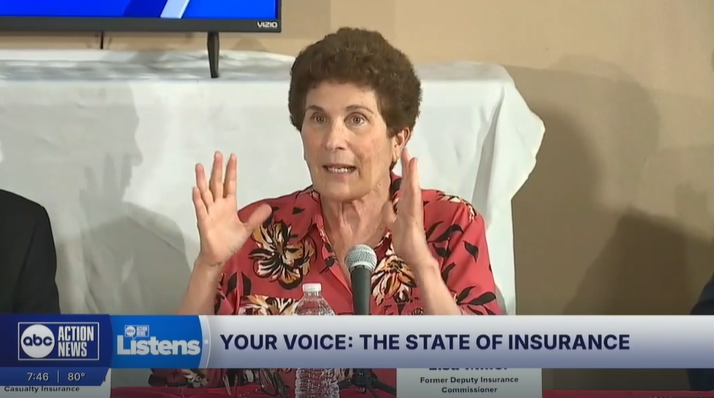
Lisa Miller at the Insurance Town Hall, June 17, 2025. Courtesy, WFTS-TV
I had the honor of talking about the importance of homeowners being proactive and about the various techniques that exist in protecting homes from storms on the Social-Engineer Podcast episode “Are you Ready for the Storm? You can watch the podcast here or listen here. Co-hosts Chris Hadnagy and Mike Holfeld (formerly of Channel 6 in Orlando) and I also talked about knowing your insurance agent, the reasons for rising rates, and being wary of answering your front door to vendors who cold-call after the storm. If you missed the recent Insurance Town Hall conducted and televised by WFTS-TV ABC Action News in Tampa, you missed a very audience-interactive and enlightening series of questions and answers revealing what’s on consumers’ minds. No worries, click the link to watch it!
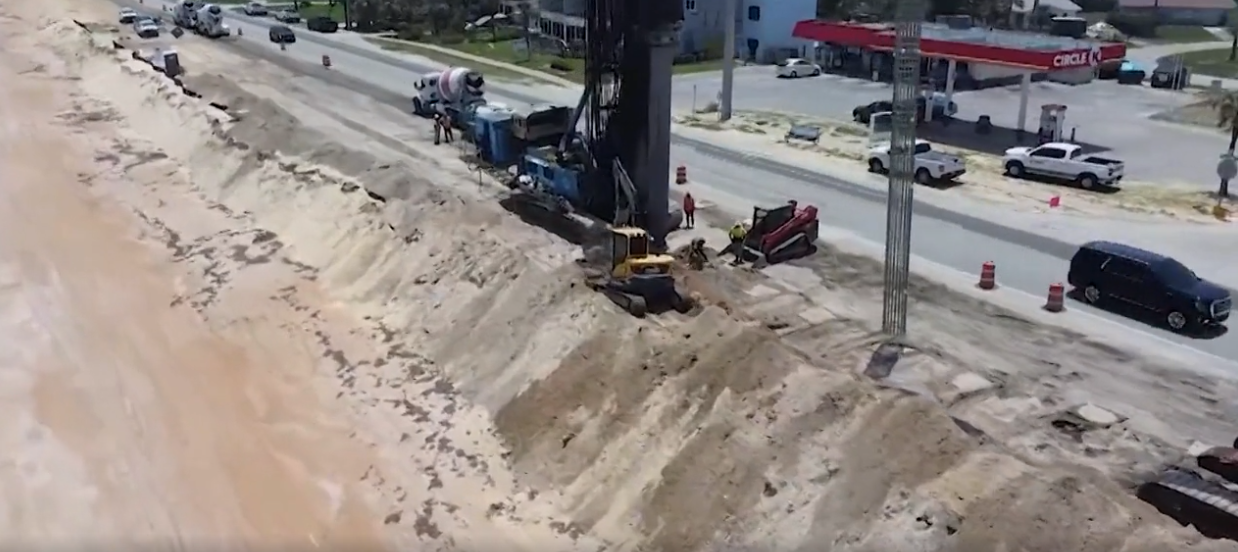
The secant wall being installed along Flagler Beach, May 2025. Courtesy, FDOT
Reinforcing A1A: The Florida Department of Transportation (FDOT) is taking proactive steps to protect Highway A1A, the scenic and historic coastal highway along Florida’s East Coast. Crews are making sure future storms won’t wreck the roads by burying secant walls into the sand along Flagler Beach and Ormond Beach, offering protection without sacrificing the view. After Hurricanes Ian and Nicole wiped out large portions of A1A in 2022, FDOT formed a “strike team” allowing coastal engineers and local communities to weigh in, brainstorming the best solution to protect the historic highway. They landed on a secant wall, which had already seen success on stretches of A1A further north, with walls of steel and fiberglass of 18 to 36 feet deep.
To construct the secant walls, teams first drill down into the beach and secure pilings and place a concrete cap down the line of pilings. Then for each of the two 1.3-mile lengths of road, dunes are reconstructed on top of the fortifications, complete with coastal plants like sea oats to restore the natural beauty of the area. The $117 million project is nearing completion by year’s end in Flagler and Volusia counties and effectively reinforces the layers of natural protection from sand dunes.
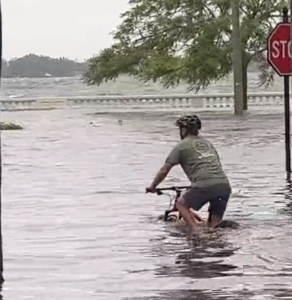
An adventurous bicyclist navigates flooded Bayshore Blvd in Tampa, from Hurricane Idlalia, August 20, 2023. Via X.
Supercharged Hurricanes: When Hurricane Idalia jumped from a Category 1 to a Category 4 storm overnight back in 2023, it left forecasters and homeowners across Florida in shock and unprepared. Now, scientists at USF have released a study theorizing that freshwater flushed into the Gulf from some 33 rivers across Gulf states may have created the perfect heat-trapping corridor for the Hurricane to follow. These “low-salinity plumes” aren’t uncommon in the Gulf, but according to Chuanmin Hu, an author on the study, it was a very unlikely confluence of factors. “In order for this to happen, you need to have the hurricane at the right time, at the right location, and that is pretty rare,” Hu said. “But this time, it’s like a perfect storm.” Hurricanes are fueled by warmer waters, and the low-salinity areas contain much more heat than surrounding saline waters. On top of that, Idalia’s lower profile and windspeeds weren’t enough to upwell the colder waters underneath the warm patches, which will usually cool down a hurricane. So in this wild chain of events, Idalia got supercharged before barreling through much of the Southeastern US, in what may have been a fluke of nature, but not one that should be written off in the future.
 LMA Newsletter of 6-30-25