

Plus, new clues in combating Red Tide
 Florida faces fire and droughts for the first time since 2011, FSU scientists investigate what mechanisms drive wildfire spread, and USF researchers identify a virus in red tide that could help predict and combat the growing problem. It’s all in this week’s Environmental & Engineering Digest.
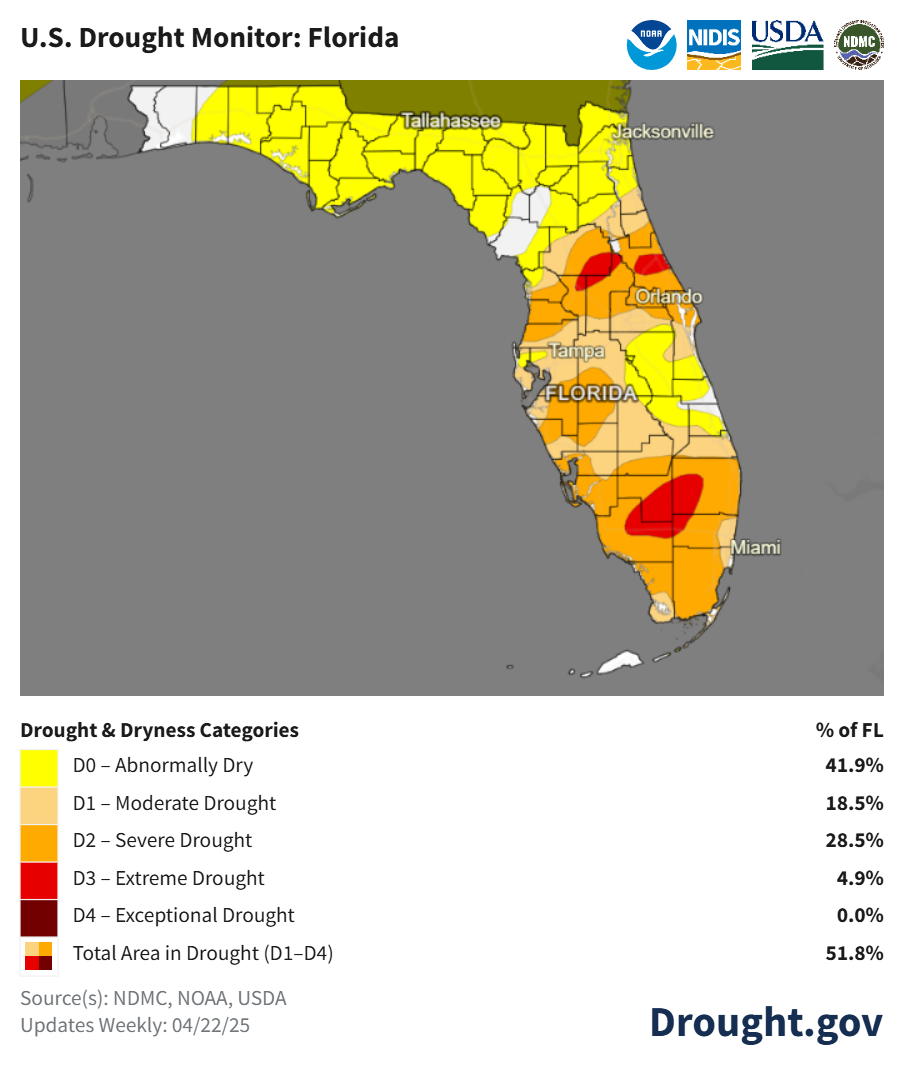 Florida Drought: Much of the Florida peninsula has been facing historical droughts over the last several weeks – with temperatures rising and humidity levels remaining low. Sadly, these are the ideal conditions for wildfires to erupt, with 89 fires burning some 3,400 acres across the state and sending smoke signals to many big metropolitan areas. Many municipalities have issued burn bans in the meantime to keep fire risk as low as possible, with areas in South Florida like Palm Beach, Broward, and Miami-Dade counties experiencing severe drought that will most likely result in crop loss and water shortages. Below historical average rainfall and a La Niña winter have exacerbated the already dry situation, with high pressure stopping any storms from moving in and refilling some of the state’s natural reservoirs, like Lake Okeechobee, which is down to around 12 feet. Readers are advised to use caution with outdoor power equipment, open flames, and anything else that can create a spark.
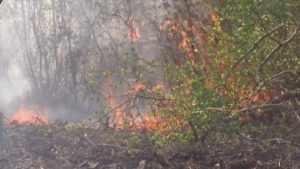
Some of the 600+ acre wildfire in Bay County, March 31, 2019
Where There’s Smoke There’s Fire: Thankfully, some of the state’s best researchers at FSU are looking into interactions that may drive wildfire spread to try and help us combat these environmental challenges. The multi-institutional team brings in expertise from various fields including meteorology, geophysical fluid dynamics, and scientific computing to develop computer models that simulate wildfires and the hundreds of variables that may contribute to their spread. One of the biggest focus points is plume density and air current relationship – the primary transport mechanism for smoke and embers, which is not yet well understood even after their central role in the devastating Palisades Fire in California earlier this year. The researchers – recent recipients of a nearly $900,000 grant from the National Science Foundation – aim to find how far plumes can carry embers, how wind crossflow speed affects plume ceilings, and the geographic spread of air quality concerns once fires start burning. Modeling these complex environments is the latest in a storied relationship between FSU’s Geophysical Fluid Dynamics Institute and the wider field of fire dynamics. Hopefully through their research the team can help the wider disaster recovery landscape better prepare for and respond to wildfires, like those currently burning in Florida.
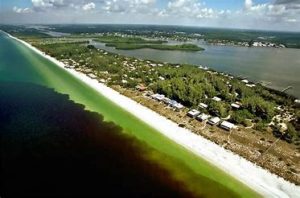
Red Tide Bloom off Florida’s Gulf Coast (undated)
Red Tide Virus: Another team of researchers further south at the University of South Florida (USF) has made what could be a groundbreaking discovery, identifying viruses within the infamous red tide blooms that cause sweeping problems for gulf states, including Florida, each year. Historically, efforts to combat the tide have focused on the macro – using satellite imagery, observations, and field sampling, but the prevalence of this new viral species may be an even better way to identify and/or kill the Karenia brevis cells that cause the blooms. Since the new virus is specific only to K. Brevis, the next steps in the research process are to experiment and see if its levels indicate anything about current blooms – or if the virus can be weaponized, since it should pose no threats to humans or larger wildlife and could kill off the now infamous phytoplankton. Study co-author Makenzie Kerr is cautiously optimistic, noting that their initial hopes are going to have to see some testing to understand the full relationship between all the variables. “There’s a lot of moving pieces,” she said, “and it’s cool to see that type of collaboration happening in our community.”
 LMA Newsletter of 4-28-25