

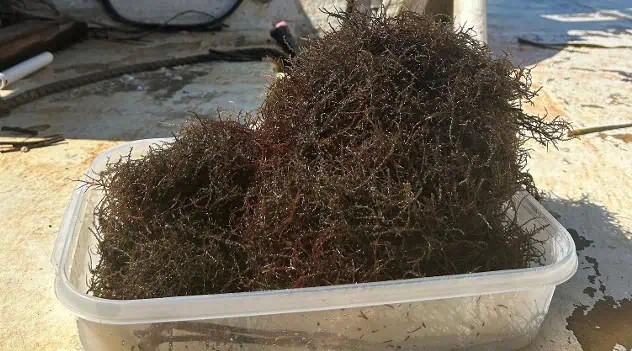
Seaweed collected by researchers in Tampa Bay this summer. Courtesy, Gabrielle Foursa, UF/IFAS
Seaweed gets a bad rap here in the Sunshine State. With tons and tons washing up on our beautiful beaches each year, most Floridians think of it more like an ocean eyesore than a cash crop. But researchers at the University of Florida’s Institute of Food and Agricultural Sciences (IFAS), Florida Sea Grant, and the University of Miami are finding that many native species of seaweed could become an incredibly profitable marine crop, with potential use in a multitude of fields from flatscreen televisions to fertilizers.
To see seaweed’s full potential, look no further than the global aquaculture landscape, which has tripled its seaweed output in the last 20 years. Mostly cultivated in parts of Asia, it has been recognized as one of the fastest-growing commodity sectors, with a remarkable role in ecosystems, even outside of its raw cash value. Dr Ashley Smyth, who leads the research team at IFAS, shared how seaweed can act as a keystone species within Florida’s delicate ecosystems. “Seaweed acts like a sponge, pulling excess nitrogen out of the water. If harvested, it removes that nitrogen completely, which means it could serve as both a product for growers and a tool for improving water quality,” Smyth said.
The next step? Early feasibility tests with industry partners to understand the sustainability and economic viability of the plant in the hands of local producers. Smyth and team say the project is still in its infancy but they remain hopeful their studies will help streamline future investments in our Florida economy and ecosystems.
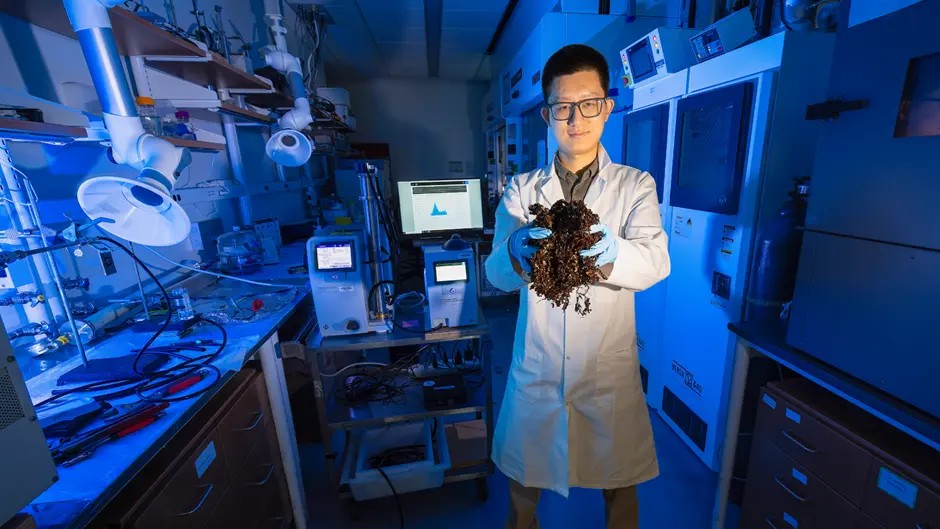
Graduate student Yiming Xi in the chemical engineering lab at the University of Miami. Courtesy, Joshua Prezant/University of Miami
Further south, a University of Miami chemical engineering student, Yiming Xi, also has his sights set on seaweed. Over the past year, the Ph.D. candidate has run a myriad of tests aerosolizing sargassum seaweed into carbon dots, which act as an alternative to quantum dots used in things like flat screen TV displays. Carbon dot technology is also in its early stages, but thanks to its fluorescent and electrochemical properties, it has been used to extend the shelf life of food, enhance bioimaging, and even help with energy storage in supercapacitors. The research could help streamline the supply chain of these carbon dots to scientists while cleaning our beaches from the infamously foul-smelling sargassum blooms. “The key part is we are taking a waste material that commonly ends up in landfills, where it could release dangerous pollutants, and converting it into something of very high value to society,” Xi said. “Our philosophy is not to call it waste but a resource.”
The possibilities seem endless, not to mention sustainable, which could mean great things for Florida’s coastal economies. Across the Sunshine State we are finding ways to stimulate the economy without having to sacrifice our beautiful and unique ecosystems.
See you on the trail,
Lisa
 LMA Newsletter of 10-6-25