

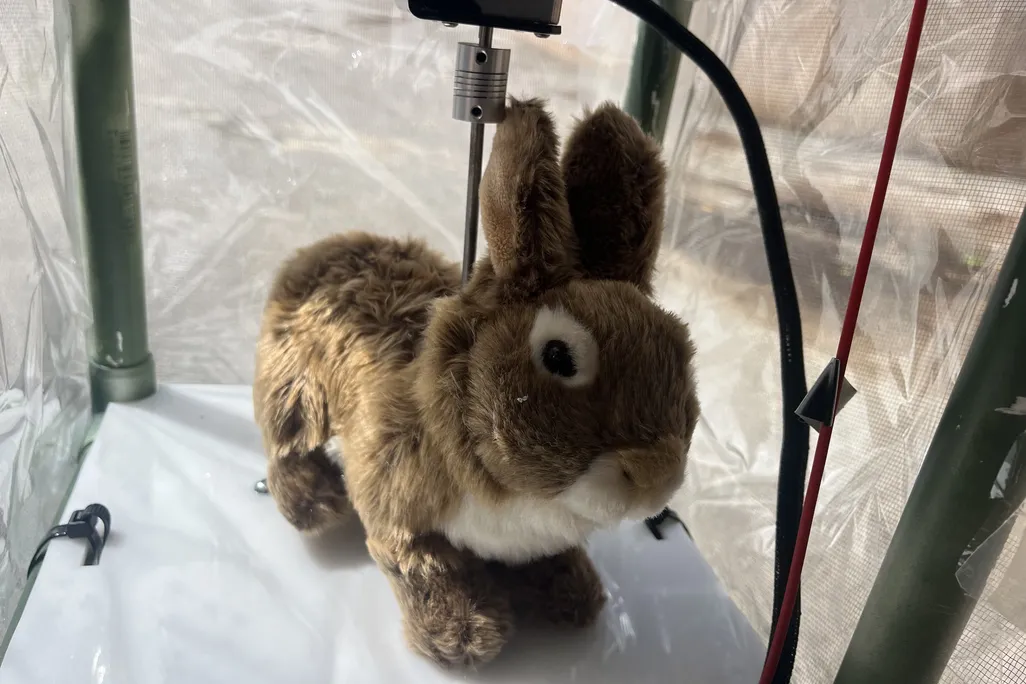
The remote controlled “Robo-Bunny.” Courtesy, Robert McCleery, University of Florida
Credit: Robert McCleery, University of Florida
The now infamous Burmese Python problem in South Florida has attracted a lot of attention and potential fixes over the years – first public hunting challenges, then contracted bounty hunters, and even tracking devices to try and locate the snake nests. But now researchers at the University of Florida (UF) think they have a solution to the invasive problem that sounds more like something out of a cartoon than a biology lab: Robo-Bunnies. These animatronic critters mimic marsh rabbits, a favorite prey of the pythons, and will be used to lure individual snakes out from swampy areas, saving biologists and trappers lots of time searching for the elusive monsters.
The South Florida Water Management District is funding the project on the tail of related research paid for by the Florida Fish and Wildlife Conservation Commission (FWC), wherein researchers found that live bait rabbits drew in about one python per week. But the process and care for the rabbits turned out to be rather intensive, so the UF team switched gears.
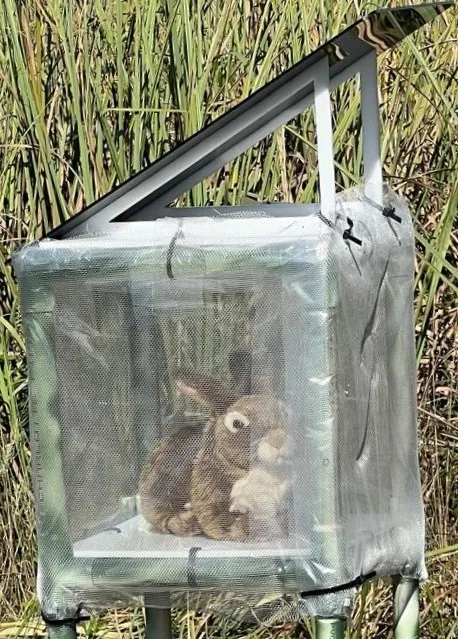
The “Robo-Bunny” in a field experiment. Courtesy, Robert McCleery, University of Florida
“Our partners have allowed us to trial these things that may sound a little crazy,” Robert McCleery, a UF wildlife ecologist who’s leading the rabbit project, told the Palm Beach Post. “Working in the Everglades for ten years, you get tired of documenting the problem. You want to address it.”
McCleery and colleague Chris Dutton outfitted 40 toy rabbits with solar-powered electrical components and cameras, then placed the rabbits at various sites for a pilot study. Each robo-bunny is remote controlled, and the heat generated from the electrical components emulates the body heat of real marsh rabbits. The result is a robot that may just check all the biometric boxes needed to fool a Burmese Python and lure it out of hiding. Anytime the cameras sense movement, they ping the researchers to watch the live video feed and check for invasives. “If that python is detected, then it contacts someone like myself, who’s available 24 hours a day, and then I can deploy one of our many contractors to go remove it,” Mike Kirkland, lead invasive animal biologist for the South Florida Water Management District, told WINK-TV. “If we can see a statistically significant number of pythons that are coming to investigate these robotic rabbits and the pens, that would be a success, because right now, pythons do a great job of staying hidden.”
But if not, they already have a backup plan: realistic rabbit scents added to the robots for further disguise. While experts generally agree that removing all of the pythons might be impossible, researchers and scientists across Florida will continue striving to restore balance in South Florida ecosystems, leveraging new technologies – no matter how cartoonish – to stay one step ahead of these serious snakes.
See you on the (bunny) trail,
Lisa
 LMA Newsletter of 7-28-25