

How the private market can help
 Floridians are left unable to renew their federal flood coverage mid-shutdown, players in the private flood insurance market say they’re ready to take over that flood risk and write often less-expensive policies, and a sit-down with a modeler and a meteorologist for a deep dive into the world of catastrophic risk modeling, extreme weather events, and their impact on property insurance, especially here in Florida. It’s all in this week’s Property Insurance News.
 Federal Flood Insurance Faltering: The federal government shutdown is having sweeping effects across the nation, one of which most pertinent to Floridians is the freeze on National Flood Insurance Program (NFIP) policy renewals. Around 150,000 policies in the Sunshine State come up for renewal each month, leaving residents on a ticking clock during this last part of hurricane season. While policies do have a 30-day grace period to catch any lapses, if this shutdown extends beyond October 31, thousands could find themselves without flood coverage in a state that sits just about at the water level. Florida has 1.7 million of the NFIP’s 4.7 million policies.
Fannie Mae and Freddie Mac are easing their rules requiring flood insurance on homes in flood zones with federally-backed mortgages, so about 1,300 home sales a day in the U.S. can still go through. Florida’s Citizens Property Insurance Corporation is deferring required proof of flood insurance on homeowners policies until NFIP resumes operations post-shutdown. Florida’s housing market is a huge chunk of the state economy, accounting for 24% of the state gross domestic product. Delays on flood coverage for new housing sales means many construction projects may have to slow down, which could exacerbate the existing housing shortage not just in the Sunshine State, but nationwide.
 Private Flood Market to the Rescue: A new report from private carrier Neptune Flood suggests that the NFIP is assuming risk better suited for the private market, finding that roughly 95% of new policyholders are eligible for private coverage. The federal flood insurance option may be dated compared to its private counterparts – legacy renewals are still stuck on the rating glide path and new NFIP policies are charged the full Risk Rating 2.0 rate. Not to mention, even with Congress forgiving $16 billion worth of the NFIP’s debt in 2018, it’s still $22.525 billion in debt according to the report. The private market seems poised to help with all the necessary tools, technology, and capacity. Estimates range from $550 million to $700 million in premiums could be shifted to the private sector each year. Of the 95% of new NFIP policyholders eligible for private coverage, 60% would pay less than they do for NFIP coverage. The first step might be ceasing NFIP sale of new policies and transforming it into a much smaller “last resort” option, the report suggests. Private flood sales have increased during the federal shutdown.
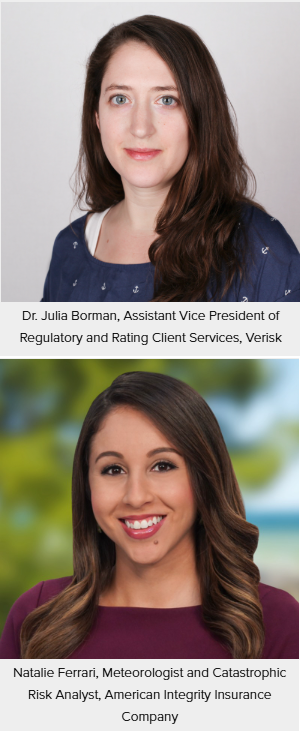 Growing Storms, Growing Risk: Catastrophe models are the backbone of modern insurance – they tell us when, where, and how hard a storm might hit and help everyone in the industry adjust accordingly. The only problem is, we’re seeing a fundamental shift in the risk landscape wherein catastrophes are no longer anomalies. I sat down with Dr. Julia Bowman, Assistant Vice President of the Regulatory and Rating Client Services Team at Verisk, and Natalie Ferrari, a Meteorologist and Catastrophic Risk Analyst for American Integrity Insurance Company, in the latest episode of The Florida Insurance Roundup podcast to better understand this “new normal.” Verisk’s recent report projects future global cat losses to $152 billion annually, up a staggering $20 billion from the average $132 billion loss in the last five years. What’s really remarkable within this research is that problems once referred to as ‘secondary perils’ are now called ‘frequency perils’ at Verisk “that can really aggregate up into a large proportion of an insurance company’s overall loss for the year,” said Bowman. Ferrari explained that she and American Integrity “look at that not only through a lens of what is likely to happen because of the perils we’re vulnerable to, but kind of how that peril could actually expand, not only along coastal areas, but even into our inland areas,” as seen in recent hurricanes Helene and Milton. We also discussed how mitigation measure and resiliency are becoming essential, and how cat modeling can and should be used by regulators in this regard as well. You can listen/read more here.
 LMA Newsletter of 10-20-25