

Plus, invasive termites are spreading beyond predictions
 South Florida is having its worst drought in years, invasive termites are spreading and threatening homes across Florida, and a bill is moving through the Florida Legislature that would restrict local governments from enacting climate change policies. It’s all in this week’s Environmental and Engineering Digest.
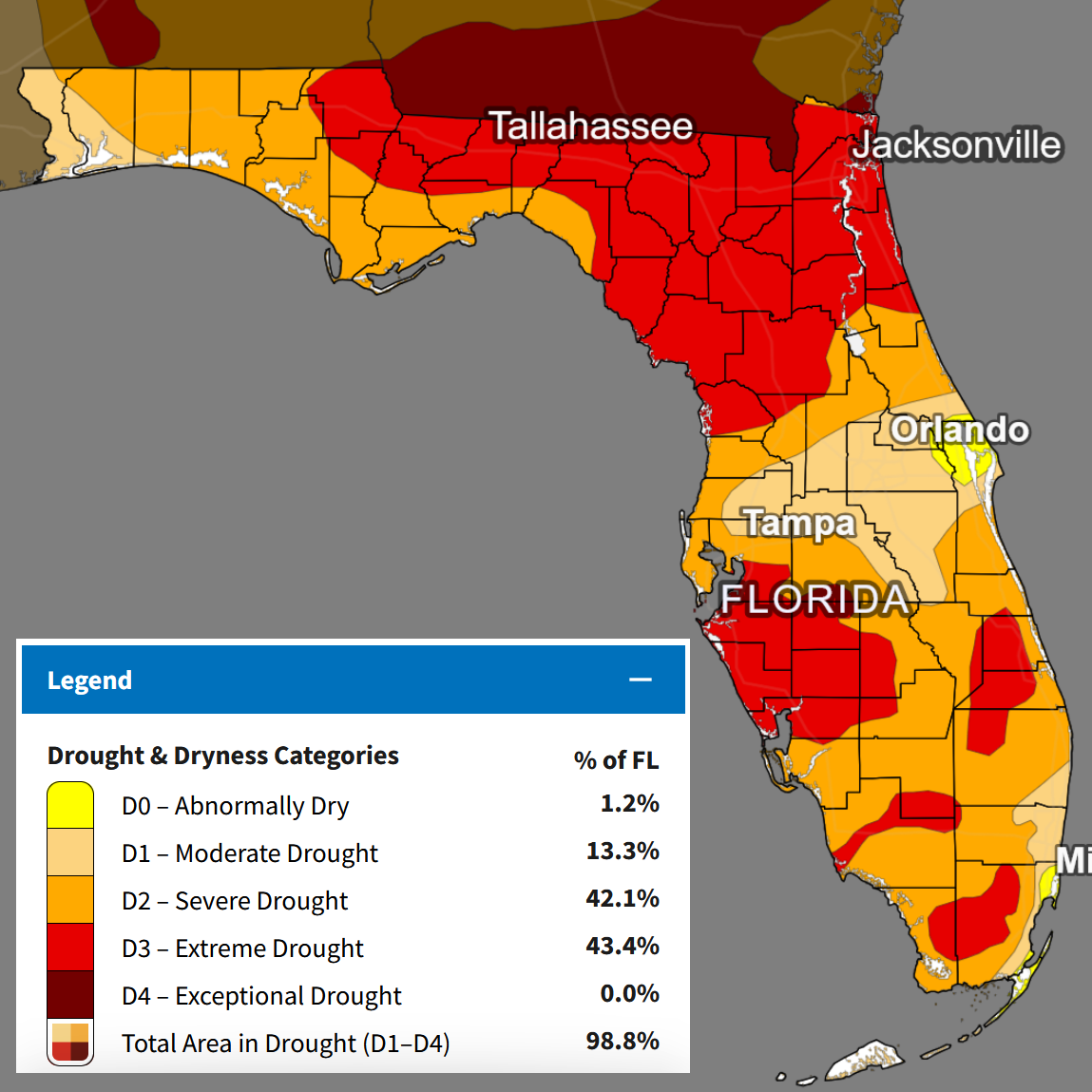
U.S. Drought Monitor: Florida, February 16, 2026.
South Florida Drought: Areas of south Florida are in quite the dry spell, with less than four inches of rain since November earning a “severe drought” designation and sparking burn bans in 34 of Florida’s 67 counties, including Miami-Dade and Monroe. The South Florida Water Management District has issued water-shortage warnings as water levels in the Biscayne Aquifer are dangerously low, which could risk saltwater intrusion into the drinking water supply. Comparatively, this is the worst drought in the area since 2007, and conditions are still worsening, with Volusia and Lake counties very close to the burn ban threshold of 500 on the Keetch Byram Drought Index, and expected to be declared “severe drought” within the coming days. With nearly 99% of Florida under some form of drought conditions, dry vegetation and low humidity mean brush fire concerns are high across the state. Voluntary restrictions have gone into effect, requesting residents limit lawn watering to twice a week to avoid mandatory restrictions if the drought continues. Sadly, there’s little to no rain in the forecast. A list of South Florida water restrictions can be found here.
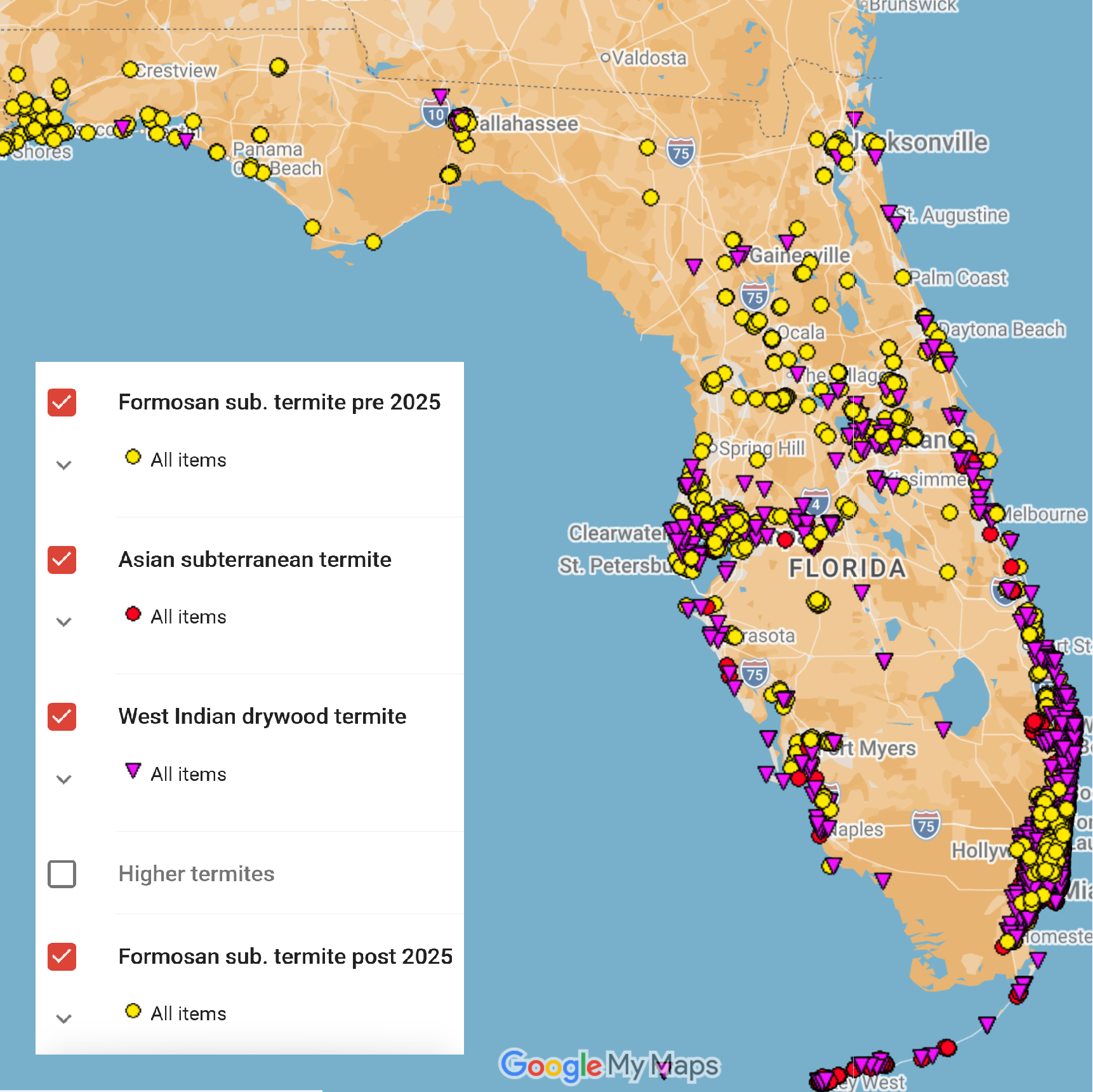
Florida Termite Distribution Map, August 2025. Courtesy, UF-IFAS
Terrible Termites: Over the last 40 years, two species of invasive termites have wreaked havoc on South Florida homes, and according to a new University of Florida study, they are still spreading, now threatening structures statewide. Pulling data from 1990 to 2025, researchers found the Formosan subterranean termite and the Asian subterranean termite have continued to expand their range, but oftentimes, their destruction went unnoticed, or at least, underestimated. “Subterranean termites have a cryptic lifestyle … where one would only notice them when damage is already extensive,” said Thomas Chouvenac, a UF associate professor of urban entomology at the Institute of Food and Agricultural Sciences (UF/IFAS). “Not only are they hard to detect without regular professional inspections, but they are also rarely reported, making the tracking of their spread much more difficult.” Researchers now expect that the Asian subterranean termite will be in all 24 of Florida’s southernmost counties before 2040 – and the Formosan subterranean termite will be across the entire Sunshine State before 2050. A partnership between UF/IFAS and hundreds of pest control providers mean the data is getting more accurate, and is publicly available via a Florida termite distribution map. Their hard work continues to inform the new North American Termite Survey, helping to identify and combat the destructive pests nationwide.
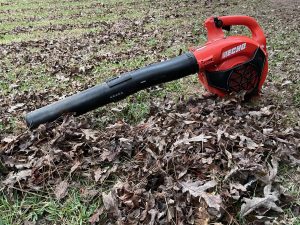 Net-Zero Restrictions: Measures are progressing in Florida’s House and Senate that would severely restrict “net-zero” climate policies from local governments. The proposal (HB 1217 and SB 1628) and its proponents, such as Senate bill sponsor Senator Bryan Avila (R-Miami Springs), argue that these policies have driven up costs for citizens and businesses alike, without a realistic goal in sight. This legislation would ban many emission-restricting plans from cities including land-development regulations, using climate considerations in purchasing decisions, or any policies that discourage the use of fossil fuels, including the leaf-blower bans we reported on back in 2024. Cities and localities across the state have already taken many of the first steps towards these “net-zero” goals, and some leaders and organizations, specifically in South Florida, have already begun to voice their concern over the measure. The measure’s chances of becoming law are unclear at this time: HB 1217 has made it through two of its four committees and SB 1628 has passed one of its three committees.
 LMA Newsletter of 2-17-26